

Public speaking skills: what five re:Invent keynotes teach speakers
Public speaking skills, the craft of rhetoric, decide on a conference stage whether a talk reaches its audience. How an organiser plans for them is visible in the programme of AWS re:Invent 2025 in Las Vegas. Amazon Web Services opened the conference on Tuesday, 2 December 2025, at 8 a.m. Pacific Time and schedules five keynotes through Thursday, as TechCrunch reported the same day. Each keynote has its own speaker with a distinct role, from the CEO via the heads of agentic AI and of the partner business to the CTO of Amazon.com, and according to TechCrunch all of them can be watched by livestream without a ticket. For speakers this means that public speaking skills are a craft with fixed working steps that you can plan for every talk, and that a talk now has to work in the room and on camera at the same time.

Public speaking skills, the craft of rhetoric, decide on a conference stage whether a talk reaches its audience. How an organiser plans for them is visible in the programme of AWS re:Invent 2025 in Las Vegas. Amazon Web Services opened the conference on Tuesday, 2 December 2025, at 8 a.m. Pacific Time and schedules five keynotes through Thursday, as TechCrunch reported the same day. Each keynote has its own speaker with a distinct role, from the CEO via the heads of agentic AI and of the partner business to the CTO of Amazon.com, and according to TechCrunch all of them can be watched by livestream without a ticket. For speakers this means that public speaking skills are a craft with fixed working steps that you can plan for every talk, and that a talk now has to work in the room and on camera at the same time.
AWS re:Invent 2025 builds its programme from five keynotes with five speakers
According to TechCrunch on 2 December 2025, the Amazon Web Services conference puts its main focus on artificial intelligence, following the 2024 edition, which was already built around it. The keynotes are spread over three days, and TechCrunch lists the speaker and the time for each. The livestreams cost nothing, and the keynotes can also be watched in Fortnite on an AWS island.
The times in Pacific Time come from the TechCrunch report, and the conversion to Central European Time, nine hours ahead, is ours. The role of each speaker is already in the programme and tells the audience what experience the speaker draws on before the first sentence is spoken. In our assessment each keynote also gets its own task, because a CEO, a head of agentic AI and a chief technology officer look at the same subject from different angles. How a keynote fits into a conference programme is explained in What is a keynote at a conference?.
Public speaking skills: what rhetoric is and which means of persuasion it knows
Rhetoric is, in the words of the English-language Wikipedia entry, the art of persuasion. Classical rhetoric distinguishes three means of persuasion that go back to Aristotle: ethos, the credibility of the speaker, pathos, the emotional state of the audience, and logos, the argument.
For a B2B conference talk this translates as follows. Ethos comes from your bio and your abstract as well as from earlier appearances, in other words from everything the audience knows about you before you speak. Pathos means that you bring your audience into a state in which it wants to listen, for example through a problem it knows from its own daily work. Because pathos depends on the state of the listener, it pays to clarify before writing who sits in the room, which task these people have to complete on the Monday after the conference and which problem stands in the way of that task, so that your opening connects with something they already know. Logos consists of a figure and a case with its reasoning, which a decision-maker can pass on to the team the next day.
At re:Invent a CEO receives ethos through the role, because the audience knows the person long before the first sentence. At a specialist conference this head start is often missing, so the opening has more work to do: within the first minutes it says where your experience comes from and which problem you solve. Public speaking skills and presentation technique mean the same core in a speaker's daily work, namely how a body of knowledge becomes a performance.
Public speaking skills start with one task per talk
Because each of the five keynotes appears to have its own task, each of your talks should have exactly one as well. The task can be written as a sentence that begins with "Afterwards the audience knows" and that contains a result a listener can repeat after the talk. A talk about supply chains might, for example, have the task that the listeners know three places where delays arise.
The task determines how much fits into the talk. Suppose you speak 130 words per minute (an assumption for this calculation), then a 20-minute talk contains a good 2,600 words and a 45-minute talk around 5,850. In 20 minutes, after two minutes of opening and two minutes of closing, about 16 minutes remain for content, and with three main points each gets a good five minutes for a statement with an example and a figure. With ten points each would get less than two minutes, which is not enough for an example. How slot lengths are distributed at conferences is described in How long is a conference talk?.
The five working steps of rhetoric in a conference talk
Classical rhetoric divides the speaker's work into five steps, which Wikipedia lists as the five canons: invention, arrangement, style, memory and delivery. Each can be applied to a conference talk:
- Invention, finding the arguments: You collect what only you can prove, such as a metric from a project, a case with an outcome or a method with a name of its own. This collection is also the basis of the abstract.
- Arrangement, the structure: You set an opening, three main points and a closing, and you word the core sentence so that it falls within the first two minutes.
- Style, the wording: You write with verbs instead of noun chains, explain every technical term when you first use it and test each sentence by whether you can say it in one breath.
- Memory, the learning by heart: You learn the opening and the closing by heart and guide yourself through the middle with three keywords, so that you speak freely and keep eye contact.
- Delivery, the talk itself: You practise voice, pace and pauses aloud with a stopwatch and mark in the manuscript the places where you stay silent for a second.
Public speaking skills in front of the room and the camera: what a livestream changes
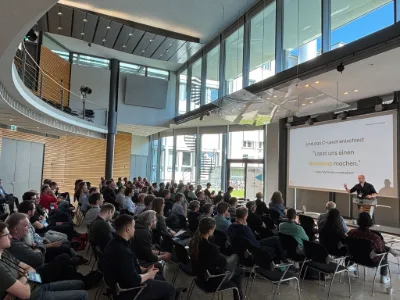
Re:Invent addresses two audiences at once. In the hall in Las Vegas sit the participants, and in front of screens viewers watch the livestream and Fortnite without needing a ticket. This also spreads the audience across time zones: two of the five keynotes begin at midnight or shortly after for viewers in Germany.
For your talks this raises a question for the organiser, which you clarify in the briefing: will the talk be streamed or recorded? If so, you are also speaking to a camera, and the opening has to work as an excerpt that someone sees without the rest. That argues for a core sentence in the first minutes that can be understood without prior knowledge.
Practising public speaking skills in four weeks: a plan for your next talk
Suppose you have a 20-minute talk in four weeks. A schedule that spreads the five working steps:
- Week 1: Fix the task of the talk as a sentence and collect the evidence that only you have (invention).
- Week 2: Write the structure with three main points and a time budget, and word the opening and closing (arrangement and style).
- Week 3: Speak the talk aloud, record it on your phone and mark on playback every sentence that was too long for one breath (memory and delivery).
- Week 4: Rehearse in front of two or three people from your target group with a stopwatch, and afterwards ask what they would pass on the next day.
Frequently asked questions
What are public speaking skills and why do speakers need them?
Public speaking skills are the abilities that let a talk persuade its audience, and the theory behind them is rhetoric, the art of persuasion. Speakers need them because a specialist talk has to establish credibility and attention within minutes and deliver an argument backed by evidence. Classical rhetoric offers three means of persuasion and five working steps for this.
Which three means of persuasion does rhetoric distinguish?
Aristotle distinguishes ethos, pathos and logos. Ethos is the credibility of the speaker, pathos the emotional state of the audience and logos the argument.
How do I practise public speaking skills for a conference talk?
You practise in four steps: fix the task of the talk as a sentence, write a structure with three main points, speak the talk aloud and record it, and then deliver it to a small test group with a stopwatch. Afterwards you ask the listeners what they would pass on the next day.
What does AWS re:Invent 2025 show about good talks?
According to TechCrunch, the conference scheduled five keynotes between 2 and 4 December 2025, each with a different speaker. In our assessment each appearance thereby gets its own task, and the same separation helps you with every talk.
How do I speak in a livestream?
You clarify in advance with the organiser whether the talk is streamed or recorded. Then you build a core sentence into the first minutes that is understandable as an excerpt, and you speak directly into the camera at times.

Marin Niehues is a management consultant and international speaker. With Niehues Consulting he works with organisations from scale-ups to DAX 40 corporations, and on stage he has collected more than 100 international conference invitations.
All articles by Marin Niehues