


How many slides does a talk need? Rules of thumb for 20, 30 and 45 minutes
A talk needs one slide for every one to one and a half minutes of speaking time, so roughly 10 to 15 slides for 20 minutes, 15 to 25 for 30 and 20 to 35 for 45 minutes. The calculation is based on the time you actually speak, and at an industry conference that is five to ten minutes less than the length in the programme. Fixed short formats prescribe the number, while talks built on pure image slides reach double that and more. What matters most to the audience is less the number than whether each slide shows exactly one statement.
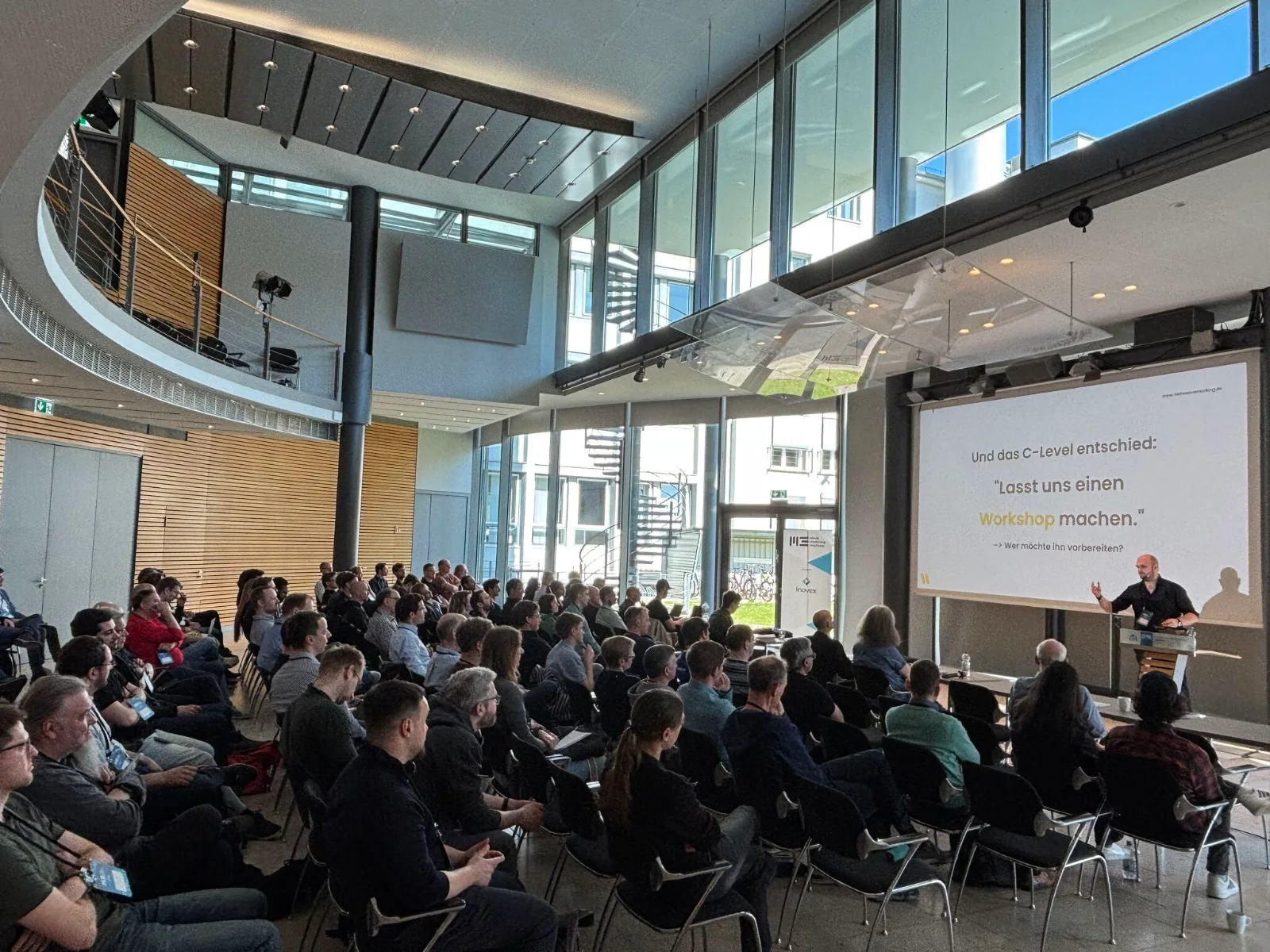
A talk needs one slide for every one to one and a half minutes of speaking time, so roughly 10 to 15 slides for 20 minutes, 15 to 25 for 30 and 20 to 35 for 45 minutes. The calculation is based on the time you actually speak, and at an industry conference that is five to ten minutes less than the length in the programme. Fixed short formats prescribe the number, while talks built on pure image slides reach double that and more. What matters most to the audience is less the number than whether each slide shows exactly one statement.
How many slides for a 20, 30 or 45 minute talk?
For a 20 minute slot you plan 10 to 15 slides, for 30 minutes 15 to 25 and for 45 minutes 20 to 35. A slot is the fixed time window a conference organiser allocates to a session, and these figures already account for the part of it taken up by the introduction, the Q&A and the changeover. If you calculate with the full length from the programme, you regularly end up with too many slides and have to cut on stage.
The rule of one slide for every one to one and a half minutes comes from the practice of expert talks in which a slide shows one statement with its evidence: a figure, a chart, a photo from a project, a short process. Explaining such a slide usually takes a minute, while a chart with two lines takes closer to two. The title slide, the outline and the closing slide count towards the total but take hardly any speaking time, which is why the upper end of the range is easy to reach once a talk has several such transitions.
The range within each length is explained by the content. A talk that follows a single project needs fewer slides than one presenting five figures from a survey, because a well told story can leave a slide up for longer. A talk with a live demonstration also needs fewer, since the demonstration itself fills time without slides.
Why speaking time counts and slot length misleads
The figure in the conference programme describes the whole time window, and your speaking time is five to ten minutes shorter. The room needs one to two minutes to settle after the changeover, the introduction takes another, and at most conferences the Q&A is part of the slot, reckoned at five to ten minutes. A 45 minute slot thus leaves around 35 minutes in which you speak, 30 minutes become 22 to 25 and 20 minutes become about 15. How these time windows are distributed at conferences is described in the article on how long a conference talk lasts.
Whether the Q&A is included in your slot is stated in the call or in the speaker briefing, the documents the organiser sends after acceptance. The note "30 minutes including Q&A" is the norm, Q&A being short for questions and answers. If the note is missing, you plan with the Q&A inside the slot, because the opposite mistake costs more: a talk planned five minutes too short gets a longer Q&A, while a talk five minutes too long loses its ending.
Interactive tool
Slide calculator
Choose the length of your slot and your presentation style. You get a guide figure for your number of slides based on the rules of thumb in this article.
This tool needs JavaScript to work.
What research says about slides and comprehension
Research on learning with words and pictures shows that people understand more when a slide contains little text and one clear statement. In his studies of multimedia learning, the psychologist Richard E. Mayer derived principles that transfer well to presentation slides. Extraneous material lowers comprehension, highlighting directs attention to what matters, and spoken words with a graphic work better than spoken words with the same text on screen. Anyone who has sat in an audience knows the last point: if the slide shows the sentence the speaker is saying, the room reads faster than the speaker talks and then stops listening.
At Pennsylvania State University, Joanna Garner and Michael Alley tested these principles in an experiment with 110 engineering students. One group learned from slides in the usual layout of a keyword heading and bullet points, the other from slides that show a statement as a full sentence at the top with visual evidence below it. The second group understood the material better, held fewer misconceptions and found the task less demanding. In a later test it also remembered more.
For the number of slides this has a surprising consequence. Showing one statement per slide produces more slides than writing three statements on one, and the talk becomes easier to follow as a result. A high slide count is therefore a sign of clarity as long as each slide is grasped quickly. A talk feels overloaded when a slide needs explaining for longer than the audience is willing to look at it.
When many slides are right: image slides and fixed formats
Fixed short formats set the number of slides bindingly. PechaKucha, developed in Tokyo in 2003 by the architects Astrid Klein and Mark Dytham, prescribes 20 slides of 20 seconds each, six minutes and forty seconds in total. An Ignite talk also uses 20 slides, which advance automatically every 15 seconds, five minutes in total. In both formats the slides set the pace, and the speaker has to follow them. What these short formats mean for speakers is covered in the article on PechaKucha and Ignite.
In the main programme there is a second style well above the rule of thumb. Some speakers show a single image, word or figure per slide and change slides in time with their sentences, so a 30 minute talk reaches 60 or 100 slides. This style keeps the pace high and works when the talk is rehearsed very precisely, since every change has to land. For a first appearance at an industry conference the rule of thumb is the safer frame, because it leaves room for questions from the floor and for spontaneous additions.
The well known 10/20/30 rule of the investor Guy Kawasaki belongs to a different setting. It calls for ten slides, twenty minutes and a font size of at least 30 points and is meant for pitches to investors, in which a founder presents a business model. For an expert talk ten slides in twenty minutes is at the low end, while the minimum font of 30 points suits any conference room, because the back row has to be able to read the slide too.
How much text belongs on a slide?
A slide should carry so little text that the audience takes it in within a few seconds and then listens to you again. A proven layout is one sentence as the heading that contains the statement of the slide, with evidence below that needs no further text: a chart with one highlighted line, a photo, a single large figure. Running text and long lists belong in a handout or in the materials many organisers send out after the conference.
A common reason for too much text is the wish to use the slides as notes at the same time. That is what presenter view is for, which shows notes and the next slide on the speaker's screen while the room sees only the slide. Almost every presentation program offers it, and many conference rooms support it if you connect your own device. You clarify with the organiser before the event whether that is possible.
Who develops the talk with you
The number of slides is the last stage of work that begins much earlier: with the question of which statement your talk holds for the audience of a particular conference and in which order you support it. That order is called the dramaturgy, and it determines how many slides a talk needs. Developing a talk usually takes several working days, and on top of that comes the search for suitable conferences and the submissions that are due months before the appearance.
Stage Starter takes this work off your hands: we develop the talk and its dramaturgy, find the right calls for papers, write the submission and submit it. A call for papers is the public call through which a conference collects talk proposals. A designer then handles the visual design of the slides, as the article on slides for a conference talk describes. Working with us starts from 990 euros net per month. How the whole path from topic to first stage fits together is shown in the guide to becoming a speaker.
Frequently asked questions
How many slides does a 30 minute talk need?
A 30 minute talk needs 15 to 25 slides. A slot of this length leaves 22 to 25 minutes of speaking time after the introduction and the Q&A, and one slide for every one to one and a half minutes gives this range. With pure image slides, 50 slides and more are common.
How many slides do I need for 10 minutes?
For ten minutes of speaking time you plan six to ten slides. Short talks usually present one thesis with one example, so a few slides are enough. Fixed formats such as Ignite use exactly 20 slides in five minutes regardless.
How many slides does a 60 minute keynote have?
A 60 minute keynote with a classic structure has 40 to 60 slides. A keynote is the main talk given to all participants of a conference, and many keynote speakers work with large image slides, which pushes the number considerably higher. Speaking time in keynotes is closer to the slot length, because they often run without a Q&A.
How long should a slide stay on screen?
A slide with a statement and evidence stays up for one to two minutes. Pure image slides change after 10 to 30 seconds, while charts with several lines need longer. If a slide stays up for more than three minutes, it usually holds more than one statement and can be split.
Do the title slide and closing slide count?
Yes, they count towards the number of slides but take hardly any speaking time. Title slide, outline and closing slide together fill one to two minutes. Extra slides in the appendix for the Q&A do not count, because you only show them when asked.
What font size do slides need in a conference room?
Slides in a conference room need at least 24 points, preferably 30 points for text and labels. The back row of a large room is often twenty metres or more from the screen, and the projector delivers less contrast than your monitor. Chart labels are the most common place where slides become unreadable.
Does every conference need my slides in advance?
Many organisers ask for the slides a few days before the event so that they run on the computer in the room. The deadline and file format are stated in the speaker briefing. For a submission to a call for papers you need no slides, since the decision rests on the abstract, the short description of the planned talk.
If you would rather not develop and submit your talk yourself alongside your day-to-day business, we can discuss in an initial consultation which stages suit your topic and how we build the talk for them.

Marin Niehues is a management consultant and international speaker. With Niehues Consulting he works with organisations from scale-ups to DAX 40 corporations, and on stage he has collected more than 100 international conference invitations.
All articles by Marin Niehues