

Speaking as a sales channel: what buyers check after AI research
Speaking as a sales channel reaches buyers who start their research with AI and still check the answers. In the 2026 B2B Buying Disconnect Report, published by TrustRadius on 15 July 2026, 63 per cent of the technology buyers surveyed used AI in their purchase journey, and 94 per cent of those users fact-checked the answers at least some of the time. At the same time, according to the report, 83 per cent of buyers shortlisted three products or fewer. In our assessment, this means that a talk at a professional conference can put your name on that short list, and that the fact-checking then meets evidence you supplied yourself.

Speaking as a sales channel reaches buyers who start their research with AI and still check the answers. In the 2026 B2B Buying Disconnect Report, published by TrustRadius on 15 July 2026, 63 per cent of the technology buyers surveyed used AI in their purchase journey, and 94 per cent of those users fact-checked the answers at least some of the time. At the same time, according to the report, 83 per cent of buyers shortlisted three products or fewer. In our assessment, this means that a talk at a professional conference can put your name on that short list, and that the fact-checking then meets evidence you supplied yourself.
The TrustRadius 2026 B2B Buying Disconnect Report in figures
The study comes from TrustRadius, a platform for business software with user reviews that has belonged to HG Insights since June 2025. It is based on a global survey from January 2026 of 1,862 technology buyers and 444 technology vendors, who were asked about the purchasing decisions of the previous year. The publisher runs a platform with user reviews and buyer data for technology vendors, so we read the study as a vendor study with its own interest in the topic of reviews. Because it concerns technology buyers and their purchasing decisions of the previous year, it serves here as an indication of behaviour patterns in B2B buying, which we transfer to talks with our own, openly stated assumptions.
The core figures from the press release of 15 July 2026 are these: 63 per cent of buyers used AI during their purchase journey, and 94 per cent of the buyers who used AI fact-checked the answers at least some of the time. 59 per cent of the purchases in the previous year involved AI tools or tools with AI features. Only 13 per cent of buyers used analyst reports, a fall of 63 per cent since 2022, and 74 per cent used reviews. Rajat Bhatnagar, SVP of Growth at HG, says: "Buyers are using AI to move faster, not to think less."
According to the report, AI changes how buyers discover vendors but hardly the factors that shape their decision. As the most influential resources in the selection, TrustRadius names, among others, product demos, prior experience of their own and user reviews. The report also observes that AI recommendations are strongly shaped by trusted content from third parties. This includes customer reviews and independent publications as well as the experiences of other buyers.
Speaking as a sales channel: where a talk takes effect in the buying process
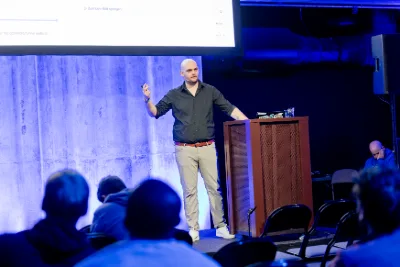
A sales channel is a route by which a provider comes into contact with potential customers. Speaking as a sales channel means that you speak at a professional conference in front of people whose work your topic affects, and that conversations and orders arise from the appearance. How this channel compares with others is described in the article Why the industry conference works so well as a sales channel.
Three points of contact for a talk can be derived from the report's figures, and all three are our interpretation and do not appear in the report as such. First, a shortlist with three places leaves little room for vendors the buyer only meets during the research, and an appearance the buyer has seen beforehand raises the chance of being named. Second, prior experience appears in the list of influential resources, and for the audience a talk is a sample of your work that they have experienced themselves. Third, AI recommendations draw on content from third parties, and a conference programme with your name, together with a recording and a report on the appearance, belongs to exactly such sources, as we describe in the article Get mentioned in ChatGPT as a speaker.
What the study does not say and where the limit of transfer lies
The report surveys buyers of software. The figures on the shortlist concern products, and whether buyers of consulting services proceed in a similar way has not been measured by TrustRadius. Consulting is usually decided on people, which tends to strengthen talks as a channel, but that too is an assumption. Who sits in the buying centre of a company and how decisions are made there is described in our article Buying centre in B2B.
A calculation for six talks a year
Because the report gives no figures on talks, the following calculation is an example with assumptions. It is kept deliberately simple. Suppose you give six talks a year, 80 people sit in each room, and one in five of them will look for a vendor on your topic within the next twelve months. That makes 16 people looking per talk and 96 a year. If one in five of them names you on the shortlist, you end up on almost 20 lists, and if one in ten of these turns into an order, two orders a year result. Whether that pays off depends on the value of an order: at 30,000 euros per order, 60,000 euros of revenue stand against the cost of six appearances. Put in your own values before you decide.
Our founder Marin Niehues has received over 100 invitations on six continents and has spoken at over 50 conferences in 30 countries, and Sessionize listed him as Most Active Speaker in 2024 and 2025. A single talk rarely brings an order, but many appearances over the years build the awareness that a short shortlist depends on. For planning, this means that you submit one topic to several conferences at once, spread the dates over the year and note after each appearance how many conversations resulted, so that the calculation above runs on your own figures instead of our assumptions.
How to turn your talk into a sales channel
- Align the topic with a reason to buy: Speak about the problem at which buyers start looking for vendors and show with a case of your own how you solved it.
- Supply evidence that can be checked: If 94 per cent of AI users check answers, listeners will do the same with your figures, so state the source, the period and the base on the slide.
- Leave traces online: Make sure your name appears in the conference programme, your bio fits the topic and a recording or a report can be found.
- Ask for voices: Ask attendees and former clients for a short verdict that you show on your site with their permission, because 74 per cent of buyers use reviews.
- Follow up: Get in touch with the people you spoke to within a few days, as we describe in What happens after the conference, and where the business comes from.
Frequently asked questions
Is speaking a worthwhile sales channel?
A talk is worthwhile if the audience includes people who buy your topic for their work, and if you follow up after the appearance. It rarely brings an order straight away, but it makes your name known before a buyer draws up a shortlist. Whether it pays off depends on the value of an order and on the number of your appearances.
What does the TrustRadius 2026 B2B Buying Disconnect Report say?
The report of 15 July 2026 is based on 1,862 technology buyers and 444 vendors and shows that 63 per cent of buyers use AI in the purchase journey. 94 per cent of these users check the answers at least some of the time.
How do B2B buyers use AI when choosing a vendor?
According to the report, most of the technology buyers surveyed use AI for research and then check the result. As the most influential resources, TrustRadius names, among others, product demos, prior experience of their own and user reviews.
How many vendors make the shortlist?
According to TrustRadius, 83 per cent of the buyers surveyed shortlisted three products or fewer. For vendors, this means that awareness before the research decides who is included.
How do you win orders through a conference talk?
You speak at a conference where your clients sit, back your statements with cases of your own and get in touch with the people you spoke to in the days afterwards. A recording, the conference programme and client voices make the appearance findable for buyers and for AI answers.

Marin Niehues is a management consultant and international speaker. With Niehues Consulting he works with organisations from scale-ups to DAX 40 corporations, and on stage he has collected more than 100 international conference invitations.
All articles by Marin Niehues