

Podcast guest or conference stage: which brings B2B experts more?
For B2B experts, the conference stage brings more clients, because decision makers can approach you directly after the talk, while a podcast appearance is quicker to get and builds visibility. As a podcast guest you speak in a conversation to listeners who hear you at any time and alone. At an industry conference, an event where professionals from one sector hear talks on their field, your audience sits together in one room and speaks to you afterwards. This article compares both routes by reach and effort and shows the costs and the order in which they can be combined.

For B2B experts, the conference stage brings more clients, because decision makers can approach you directly after the talk, while a podcast appearance is quicker to get and builds visibility. As a podcast guest you speak in a conversation to listeners who hear you at any time and alone. At an industry conference, an event where professionals from one sector hear talks on their field, your audience sits together in one room and speaks to you afterwards. This article compares both routes by reach and effort and shows the costs and the order in which they can be combined.
Does a podcast appearance as an expert bring clients?
A podcast appearance brings clients if the listeners belong to your target group, and it works mainly through awareness and trust. A podcast appearance is a recorded conversation that a host has with you and later publishes as an episode. The hurdle is low, because many industry podcasts look for guests all the time and you write to the editors directly. Often only a few weeks pass between request and recording, and the recording takes an hour or less at your desk. An episode stays available and serves as an audio sample for later requests.
The audience sets the podcast a limit. People listen while commuting or on the side at their desk and stay anonymous. You do not learn who listened, and listeners cannot ask you a question. What matters is the share of your target group among the listeners, and it is often higher for small industry podcasts than for those with a large reach. A look at the audience is therefore worth more than a look at download figures, and editors usually answer the question of who listens.
What a talk on the conference stage achieves
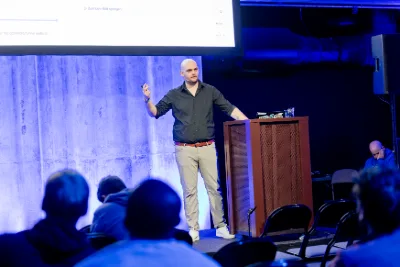
A talk at an industry conference brings you into conversation with decision makers who have deliberately chosen your topic. It requires a programme committee, the group that decides on talks at a conference, to select your proposal. Conferences usually collect proposals through a call for papers, the public announcement of their speaking slots. A proposal consists of a title and a bio plus an abstract, the short description of the talk. According to our analysis of 2,415 conferences that publicly advertise speaking slots for 2026, the median gap between submission deadline and conference start is 50 days, so half a year often passes between idea and stage.
In return you get something a podcast does not offer. Your audience has set aside time for this conference and chosen its topic, often with paid travel and a paid ticket. Selection by the programme committee works as a recommendation, because whoever stands on stage counts as someone experts consider relevant. After the talk the audience goes into the break and comes to you. This is where the conversations B2B sales aims for arise, and why the industry conference works so well as a sales channel explains why.
In our experience, a well-matched talk leads to around five serious conversations, two meetings come out of them, and every third meeting becomes paid work. There is no comparable figure for a podcast appearance, because listeners and conversations can hardly be connected.
Which brings more clients, a talk or a podcast?
In B2B, a talk at an industry conference brings more clients, because the audience sits in the same room and can approach you directly. In B2B a single person rarely buys alone: in complex purchases, people from several functions decide together in what is called the buying center, and research on the buying process consistently shows that buyers spend only a small part of their buying journey talking to vendors, with all vendors combined. The rest of the time they inform themselves. How such a group works is explained in the buying center in B2B.
Both formats tap into this self-study, but at different points. The podcast belongs to the phase in which someone is getting to grips with a topic: a department head hears you and remembers the name, which helps you as soon as that name appears on a list of possible vendors. The conference belongs to the phase in which someone has a concrete problem and wants to talk to a person who can solve it. They hear your talk, ask a question and often arrange a meeting the same day.
Effort and cost compared
For a podcast you need a topic, a short profile for editors and some patience with requests. For a conference you also need a talk for an expert audience, abstracts that convince a programme committee and a list of suitable conferences. The acceptance rate shows the scale of the work: of 1,374 decided abstracts from our own submissions for clients, 94 were accepted, roughly 7 per cent. Per conference we reach up to 19 per cent, because several abstracts often go to the same conference and one acceptance is enough, whereas the market typically sees 5 per cent at most at this volume of submissions.
On the cost side, a podcast involves hardly any spending as long as you appear as an invited guest. There are also paid guest spots, known as pay to play: mainly in the US market, smaller shows charge a few hundred to around two thousand dollars per episode and large podcasts five figures, and an expert audience hears such episodes as advertising. A conference costs travel days, two for a one-day talk in another city, three with a long journey or an evening before, plus the preparation. What does a conference talk cost? lists the items. With pay to speak, an organiser sells the speaking slot, and that easily means €10,000 or more for a single speaking slot. A bought slot is often labelled in the programme, and the expert audience hears it as advertising.
Do podcast guests or speakers get paid?
As a podcast guest you are usually not paid, and industry conferences with a call for papers mostly pay selected speakers no fee either. Organisers pay fees mainly for keynotes and corporate events: in Germany, newcomers receive about €1,000 to €3,000 per talk, established experts €3,000 to €6,000, well-known keynote speakers €6,000 to €15,000, and celebrities €15,000 to €50,000 and more. The pillar article speaker fees covers the levels and how to negotiate them.
For B2B experts a different calculation counts, because a single client won from a talk is worth more than any fee. If an engagement is worth €30,000 to you, one client won already exceeds the newcomer fee many times over. Stage Starter therefore brings experts onto industry stages where their clients sit.
Podcast guest or talk: which route suits which situation
A podcast suits you if you are just starting to present yourself as an expert and have a topic you can talk about for half an hour without slides. You can pull quotes for LinkedIn from an episode, and the recording shows you which questions listeners ask. How other channels compare with the conference stage is shown in webinar, trade fair, LinkedIn or conference stage.
The conference stage suits you if you want to win clients who have a concrete problem and can pay. That applies to consultants and service providers whose offer needs explaining and whose purchase decision involves several people, because for them the conversation counts for more than reach. Four to six talks a year cover the share the stage takes on in winning new business, and one to three are realistic in the first year.
How the two routes can be combined
B2B experts do best when they use both routes in a fixed order. The talk comes first, because it becomes the abstract, the conversation topic for podcasts and later posts for LinkedIn. Then the conference submissions run, whose replies take weeks or months, and podcast appearances keep you visible during this wait. The first recording also serves as an audio sample when an organiser wants to know how you speak.
Stage Starter takes on this work for you: we find the right calls, write the submission and submit it, then follow up and accompany you to the stage, as the Stage Starter page describes. We need your expertise and a single approval of the talk and the abstracts before the start, and you do not approve every single submission. The collaboration starts from €990 net per month, and if you want a written roadmap first, you begin with the Speaker Audit from €2,000 net, which is credited when you hire the agency. The programme committee decides on every submission, which is why no agency can guarantee an acceptance.
Frequently asked questions
Does a podcast appearance as an expert bring clients?
A podcast appearance brings clients if the listeners belong to your target group and someone gets in touch after the episode. It works through awareness and trust, and direct conversations arise less often. Ask the editors before agreeing which sectors the listeners come from.
Which brings more clients, a talk or a podcast?
In B2B, a talk at an industry conference brings more clients, because the audience sits in the same room and can approach you after the talk. A podcast brings visibility and trust. If you lack conversations with decision makers, the stage is the stronger route, and if you lack awareness in a new field, the podcast is the faster one.
How do I get onto a podcast as an expert?
You write to the editors of an industry podcast directly and explain in two sentences what listeners gain from your topic. An audio sample or a recording of a talk helps. Often only a few weeks pass between request and recording.
How do I find suitable B2B podcasts?
You find suitable B2B podcasts by searching podcast apps for your industry term, through trade media and associations that run their own podcasts, and by asking clients what they listen to. What matters is the share of your target group among the listeners. Small industry podcasts often reach that group more precisely than formats with a large reach.
What does it cost to appear as a podcast guest?
As an invited guest you pay nothing. Paid guest spots, known as pay to play, cost a few hundred to around two thousand dollars per episode for smaller shows, mainly in the US market, and five figures for large podcasts. An expert audience hears such episodes as advertising, like a bought speaking slot at a conference.
How do I prepare for a podcast interview?
Listen to two or three episodes beforehand so you know the tone and length, and agree the topics with the host without learning answers by heart. A quiet room, an external microphone and a stable connection noticeably improve the sound. Have two concrete examples from your work ready, because listeners remember stories better than claims.
Is it worth starting your own podcast instead of guest appearances?
Your own podcast is worth it if you can produce episodes regularly over months and your guests themselves belong to your target group. The effort per episode is well above that of a guest appearance, and your own audience grows slowly. Guest appearances use the audience someone else has already built.
Can I combine podcast appearances and conference talks?
Yes, both use the same talk as their basis. While conference submissions wait for an answer, podcast appearances keep you visible. A podcast conversation also serves organisers as an audio sample.
If you want to know which industry conferences suit your topic and how podcast and stage would work together for you, we can work that out in an initial call.

Marin Niehues is a management consultant and international speaker. With Niehues Consulting he works with organisations from scale-ups to DAX 40 corporations, and on stage he has collected more than 100 international conference invitations.
All articles by Marin Niehues