

Consultants as speakers: What LinkedIn’s new AI search changes
Consultants as speakers will increasingly be found through whole sentences on LinkedIn, because the platform is adding natural-language queries to its people search. As TechCrunch reported on Thursday, 13 November 2025, the AI-powered people search is launching first for premium users in the United States, with other regions to follow in the coming months. Instead of entering an exact job title or a string of filters, users describe the person they are looking for, for example investors in the healthcare sector with FDA experience. For consultants who speak at industry conferences, it follows that their profile should name their topic, their sector and their talks in the words a client would use to phrase the request.

Consultants as speakers will increasingly be found through whole sentences on LinkedIn, because the platform is adding natural-language queries to its people search. As TechCrunch reported on Thursday, 13 November 2025, the AI-powered people search is launching first for premium users in the United States, with other regions to follow in the coming months. Instead of entering an exact job title or a string of filters, users describe the person they are looking for, for example investors in the healthcare sector with FDA experience. For consultants who speak at industry conferences, it follows that their profile should name their topic, their sector and their talks in the words a client would use to phrase the request.
What LinkedIn announced for people search on 13 November 2025
According to Ivan Mehta’s report at TechCrunch, LinkedIn is extending a feature that it introduced earlier in the year for job search among members in the United States. As examples of queries, TechCrunch names a search for investors in the healthcare sector with FDA experience, for people who co-founded a productivity company and live in New York City, and the question of who in your own network can help you understand wireless networks. Members with access see the text “I’m looking for…” in the search bar instead of “Search”.
Rohan Rajiv, Senior Director of Product Management at LinkedIn, describes the aim of the search to TechCrunch as follows:
The new AI-powered people search is designed to be the fastest path to the person who can help you the most.
Rohan Rajiv, Senior Director of Product Management at LinkedIn, as quoted by TechCrunch on 13 November 2025
In early tests, members used the feature, according to the report, to find contacts for new jobs, for growing their business or for their careers. TechCrunch also names the limits: the terms “Y Combinator” and “YC startup” lead to different results, and a search for founders of voice AI startups sometimes surfaces people with the “Top Voice” badge. LinkedIn says it is working on understanding queries better. The report gives no date for the German-speaking countries.
Consultants as speakers need a profile that answers whole requests
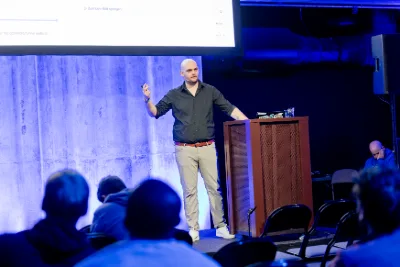
A consultant as speaker is a consultant who presents their expertise on conference stages and becomes visible to the people who buy exactly that expertise. Many independent consultants and executives call themselves a speaker, a presenter or a keynote speaker, and our article Speaker, Referent, Redner: what is the difference? explains which label suits which appearance.
Whatever the title, the same point applies that the TechCrunch report makes about the previous search: it required the exact title or several filters. In our assessment, a consultant who calls herself “Senior Consultant” offered a search for supply chain resilience hardly anything to match. A query in whole sentences can instead match words that appear anywhere in the profile, and the wording of the profile then decides whether a consultant fits a question.
LinkedIn has not explained in the announcement how it weights results. Everything else in this article about building a profile is therefore our own assessment and gives no account of LinkedIn’s ranking.
A worked example shows how many places in a profile name the topic
Let us work it through. Suppose a consultant advises machine builders on the resilience of their supply chains and gives six talks a year. Her profile A has the headline “Senior Consultant”, a summary with general experience in strategy and digitalisation, and no talks at all. Her profile B has the headline “Supply chain resilience for machine building”, two sentences in the summary about the problem she solves, and all six talks listed under appearances with topic, conference, date and place.
In profile A the topic appears in no place. In profile B it appears in eight places: in the headline, in the two sentences of the summary and in the six appearances. A query for “someone who helps machine builders with the resilience of their supply chains” meets every one of those words in profile B. Whether the search then also ranks the profile high remains open. The only certainty is that profile A offers nothing at any point for the query to refer to.
The figures belong to a worked example with the assumptions from the paragraph above and come from no measurement. The numbers are therefore constructed. Each talk listed adds one place where the topic appears in a complete sentence, and that relationship holds for other figures as well.
Talks are the evidence a consultant’s profile needs
Consulting is a business of trust. Someone who finds a consultant through search will, in our assessment, want to know next whether she knows the topic. A talk at an industry conference answers that question from the outside: a programme committee selected the topic, and the conference names the date and place. For a profile, each talk therefore supplies a line with three details that a buyer can check.
For that reason it is worth describing each appearance, in our assessment, with a sentence that names the question the talk addressed. “Talk on supply chains” matches hardly any query, whereas “How machine builders reconnect their suppliers within four weeks after an outage” answers a question that a purchasing manager could ask in exactly those words. Which topics are in demand at conferences is shown in our analysis Which topics dominate business events and conferences, and why the route to the stage pays off for consultants is described in Why should I become a speaker?.
A profile with verifiable appearances answers the question about experience with a topic before a buyer asks it, and at the same time it gives the search words to match.
AI search rewards the spellings that a buyer actually types
The example of “Y Combinator” and “YC startup” shows that the search does not always treat related terms alike. For a consultant’s profile that means using the spellings clients use, and in case of doubt both. Someone who advises on supply chains writes “Lieferkettenresilienz” in one place and “supply chain resilience” in another, because both spellings occur in the field.
The same applies to the name of the appearance. Sometimes it is called a talk, sometimes a keynote, sometimes an impulse talk or a panel, and the article What formats are there at a conference? distinguishes the formats. Naming the formats correctly in the profile helps both a search and a reader who wants to place the appearance.
Five steps for consultants as speakers
- Define your topic in one sentence: Formulate which problem you solve for which sector, in the way a buyer would type it into a search bar.
- Adapt the headline and summary: Put that topic in the headline and describe in two sentences in the summary what your client can do better afterwards.
- List talks as appearances: Give each talk its topic, conference, date and place, and describe in one sentence which question it answered.
- Align spellings: Use both German and English technical terms where both are common in your field.
- Search for yourself: As soon as the feature is available in your country, type your ideal client’s question as a whole sentence into the search and note whether your profile appears and which place triggered the match.
Frequently asked questions
How are consultants as speakers found on LinkedIn?
Consultants as speakers are found when their profile names their topic and sector in the words a buyer searches with. The new AI people search, which TechCrunch reported on 13 November 2025, understands queries in whole sentences. Talks listed with topic, conference, date and place add further places where the topic appears.
Who can use LinkedIn’s new AI people search?
According to TechCrunch, the search launches first for premium users in the United States and is due to reach further regions in the coming months. The report gives no date for the German-speaking countries. Members with access see the text “I’m looking for…” in the search bar.
What is a consultant as speaker?
A consultant as speaker presents their expertise at conferences so that clients see them as an expert and hire them. They give talks, keynotes or impulse talks at industry events in their field and use them as evidence of their competence.
How do I show talks in a LinkedIn profile?
Give each talk its topic, conference, date and place, and add a sentence on which question it answered. The topic then appears in a complete sentence in the profile, and a buyer can check the appearance. LinkedIn has not published how it weights these places.
How do talks affect client acquisition for consultants?
A talk at an industry conference reaches people who are already concerned with the topic, and it leaves a verifiable line in the profile. How many engagements result depends on the topic and on the follow-up. There is no guarantee of that.

Marin Niehues is a management consultant and international speaker. With Niehues Consulting he works with organisations from scale-ups to DAX 40 corporations, and on stage he has collected more than 100 international conference invitations.
All articles by Marin Niehues