

Conference networking: why organisers rate it more critically
Conference networking is rated far more critically by organisers in 2026 than a year earlier: in the "2026 State of Events Benchmark Report" by Bizzabo, a provider for B2B event programmes, only 15 per cent of the organisers surveyed call their networking opportunities very effective, compared with 46 per cent in 2025, as Bizzabo published on its blog on 18 February 2026. According to Bizzabo, sponsors expect qualified conversations backed by credible data, and 40 per cent of organisers report difficulty proving event ROI in 2026. For speakers this means that a talk with a conversation offer built in gives organisers and sponsors what they are looking for. A speaker who holds targeted conversations after the session uses the stage for contacts that would otherwise be left to chance at the conference.
Conference networking is rated far more critically by organisers in 2026 than a year earlier: in the "2026 State of Events Benchmark Report" by Bizzabo, a provider for B2B event programmes, only 15 per cent of the organisers surveyed call their networking opportunities very effective, compared with 46 per cent in 2025, as Bizzabo published on its blog on 18 February 2026. According to Bizzabo, sponsors expect qualified conversations backed by credible data, and 40 per cent of organisers report difficulty proving event ROI in 2026. For speakers this means that a talk with a conversation offer built in gives organisers and sponsors what they are looking for. A speaker who holds targeted conversations after the session uses the stage for contacts that would otherwise be left to chance at the conference.
Conference networking according to Bizzabo 2026: 15 instead of 46 per cent
The post on the Bizzabo blog was written by Kerri Moore, Senior Content Marketing Manager at Bizzabo, and presents the "Listen" chapter of the 2026 State of Events Benchmark Report. According to Bizzabo, the chapter draws on surveys of event professionals, that is, the teams that plan conferences. On networking, Bizzabo writes that it remains central to the value of an event, but that the data shows an emerging tension.
As to the figures: in 2026, 60 per cent of organisers call their networking opportunities "somewhat effective" and 15 per cent "very effective", whereas a year earlier, according to Bizzabo, 46 per cent chose "very effective" and 36 per cent "somewhat effective". The share of very positive ratings has thus fallen by 31 percentage points, which arithmetically is a decline of two thirds. Bizzabo reads the change as a sign of rising expectations and writes that casual formats alone may no longer deliver consistent outcomes. The post does not state the number of respondents, and it is the organisers who rated their own offerings.
What conference networking is and why it matters to speakers
Conference networking is the deliberate building of business contacts around an event, for example in breaks, at evening formats or after a talk. For organisers it is part of the promise to attendees and sponsors. For you as a speaker it is the route by which an appearance turns into a conversation and a conversation into a commission, as we described in the article industry conference as a sales channel.
Two further figures from the study put the organisers' situation in context. According to Bizzabo, sponsors expect qualified conversations backed by credible data, and in 2026 40 per cent of organisers report difficulty proving the ROI of their events, compared with 70 per cent in 2025. Nearly half of the respondents still struggle to connect event activities to pipeline and revenue. Anyone who creates conversations with a clear occasion helps the organiser with this task, which is our interpretation of the figures and does not appear in the study in this form.
Your talk as a networking format at the conference
A talk differs from a conversation in the coffee break in one respect: the room knows beforehand who you are and which view you represent. Anyone who approaches you afterwards already knows your topic and saves you the introduction with which a conversation at a standing table begins. How the audience at an industry conference is composed and why people are there is shown in the article audience at industry conferences.
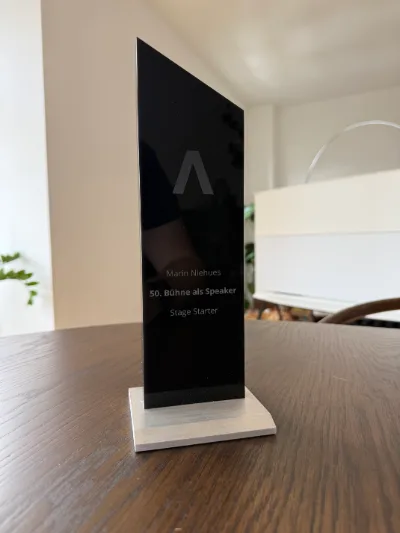
Our founder Marin Niehues has spoken at more than 50 conferences in 30 countries and therefore plans the conversations after a talk in advance. The table is our assessment and does not reproduce figures from the Bizzabo study.
Planning conference networking: the calculation for the hour after your talk
A calculation with open assumptions shows how short the time after a talk is. Assume 100 people sit in the room and a break of 60 minutes follows your talk. Assume a conversation lasts five minutes, then you manage at most twelve conversations in this break, that is, with one eighth of the audience. The more people approach you, the more it matters whom you talk to.
A conversation offer that addresses the right people helps here. If you tell the room at the close of your talk that you would like to speak with everyone who has a particular decision to make in the coming months, it is rather those people who approach you, and the twelve conversations of the break then revolve around questions where you can help.
How to build networking into your appearance
Five steps can be derived from the figures and the calculation, and you can apply them at every appearance:
- Put a conversation offer at the close of the talk: Name a topic or a decision on which you can help in conversation, and describe the people it applies to.
- Name place and time: Say where you can be found in the break, for example at the exit of the room or at a standing table, so that nobody has to search.
- Prepare one question per conversation: A question such as "Which decision is coming up for you in the next few months?" brings the conversation to the other person's situation.
- Take notes after each conversation: Name, company, topic and the agreed next step should be written down within a few minutes, otherwise the conversations blur after the tenth.
- Send the message quickly: Assume you write within two days, then the other person still remembers the talk and your offer.
How the hours after the appearance unfold and which stations a conference has for speakers is covered in the article how a conference works as a speaker.
What organisers and sponsors expect from speakers
The study shows organisers under pressure: sponsors want qualified conversations, and 40 per cent of organisers struggle to prove the ROI of their events. A speaker who describes in the abstract which question participants can explore with them after the talk gives the programme committee evidence of value beyond the talk. That is our suggestion for the abstract if you want to sharpen it.
A single appearance remains a beginning. At the roughly 10 per cent acceptance rate that Marin Niehues reaches with his submissions today, ten submissions lead on average to one appearance, and every appearance produces the conversations you planned above.
Frequently asked questions
How does conference networking work for speakers?
As a speaker you use the talk as an occasion for conversation: at the close you name a topic you like to talk about, say where you can be found in the break, and hold the conversations with a prepared question. Afterwards you write a short message within a few days to everyone you spoke with.
How effective is conference networking according to Bizzabo?
According to Bizzabo's 2026 State of Events Benchmark Report, only 15 per cent of the organisers surveyed rate their networking opportunities as very effective, compared with 46 per cent in 2025. In 2026, 60 per cent call them somewhat effective. It is the organisers' own assessment of their offerings.
Why is the rating of conference networking falling?
Bizzabo reads the decline as a sign of rising expectations. Sponsors want qualified conversations backed by credible data, and in Bizzabo's view casual formats alone may no longer deliver consistent outcomes.
How many conversations can a speaker have after a talk?
That depends on the break. With a break of 60 minutes and five minutes per conversation it is at most twelve conversations. A conversation offer at the close of the talk makes sure that the people who fit your topic come to you.
When should I follow up with contacts after a conference?
Our recommendation is to write within two days of the talk, while the other person still remembers the conversation. The message names the topic of the conversation and the agreed next step.

Marin Niehues is a management consultant and international speaker. With Niehues Consulting he works with organisations from scale-ups to DAX 40 corporations, and on stage he has collected more than 100 international conference invitations.
All articles by Marin Niehues