

Build expert authority: buyers check AI answers with people
To build expert authority in 2026 means to stay checkable for buyers who have already been advised by an AI. According to a Gartner survey of 645 B2B buyers, which Gartner presented on 20 May 2026 at the Gartner CSO & Sales Leader Conference in Las Vegas, 69 per cent turn to sales reps to validate AI-generated insights. At the same time, 45 per cent of the buyers surveyed used generative AI in their most recent purchase, mainly to research vendors and products. For speakers and consultants, this means that after a machine has given its answer, a person is asked, and that this person has better prospects if the buyer already knows them from a conference stage. That conclusion is our own interpretation, because the survey itself examines behaviour towards sales reps.

To build expert authority in 2026 means to stay checkable for buyers who have already been advised by an AI. According to a Gartner survey of 645 B2B buyers, which Gartner presented on 20 May 2026 at the Gartner CSO & Sales Leader Conference in Las Vegas, 69 per cent turn to sales reps to validate AI-generated insights. At the same time, 45 per cent of the buyers surveyed used generative AI in their most recent purchase, mainly to research vendors and products. For speakers and consultants, this means that after a machine has given its answer, a person is asked, and that this person has better prospects if the buyer already knows them from a conference stage. That conclusion is our own interpretation, because the survey itself examines behaviour towards sales reps.
What the Gartner survey of 20 May 2026 shows about B2B buyers and AI
The survey comes from Gartner's sales practice. According to the press release distributed by Business Wire, the 645 respondents used an average of seven information sources in a recent purchase.
The contradiction in these figures is only an apparent one. Most buyers want to prepare a purchase on their own and use digital tools to do so, and a similarly large majority checks the result with a person before they commit. Robert Blaisdell, Vice President Analyst in Gartner's sales practice, concludes that sellers need to show up differently: where they can help buyers validate information and reduce risk. The trade publication MarTech picked up the story on the same day, gave no figures on the number of respondents or the method, and advises marketing teams to build credibility signals such as analyst reports, customer stories and case studies from which AI systems can draw correct information.
Building expert authority means being checked by people
Expert authority is the attribution by third parties that someone gives reliable answers in a field. It arises at the point where a buyer wants to check a claim and can name a person they trust to help. The Gartner figures describe exactly this point: the AI delivers the first answer, and for the decision the buyer asks for a second opinion from someone with a name and a face.
This shifts things for independent professionals and consultants. Self-employed experts who sell on their own are themselves the sales rep whom buyers in the Gartner survey ask. The checking conversation happens with you. It goes differently if the buyer has heard you speak before, because then they begin with an impression they gained themselves.
How a conference stage helps you build expert authority
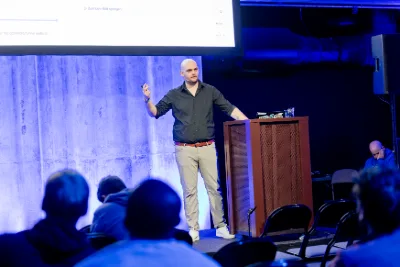
The study says nothing about conferences, so what follows is our own reasoning. A talk at a professional conference creates something that a web text struggles to create: a buyer sees how you answer questions, and sees that a programme committee selected you. If that buyer later asks an AI for suppliers for their problem, and then wants to check the answer with a person who knows the field and whose judgement they can defend to their team, they already have a name in mind for that check.
Buying decisions in B2B are also rarely made by one person. Gartner names securing internal support as one of the tasks for which sales reps remain the most important source. Someone who sat in the room can say in their own company that they saw the person live, and in the buying centre, where several people assess a supplier, that is an argument with weight.
A calculation shows the order of magnitude, and it rests on assumptions. Suppose you give six talks a year to 120 professionals each from your target group, which means you reach 720 people. If Gartner's 69 per cent applied to this group as well, around 500 of them would approach a person for confirmation when making a purchase. Applied to Gartner's 645 respondents, that is 445 buyers for whom confirmation by a person belongs to the buying process. Whether buyers think of you then depends above all on whether they already know you, and you influence that part by choosing the stage.
Build expert authority in five steps
The figures and the reasoning above suggest a sequence you can start within a quarter:
- Define a core thesis with a case of your own: choose one statement you can substantiate from your own work, such as a figure from a project. Anyone who is going to be checked needs something that can be checked.
- Choose stages where your buyers sit: a conference with 300 attendees from your target group brings you more than one with 3,000 from the wrong industry. How to find such stages is covered in How to find the right conferences.
- Prepare the checking conversation: after your talk, have a page or a short document ready in which your substantiated claims appear with their sources, so that a buyer can quickly compare their AI answer with yours.
- Keep your traces visible: the programme page, the recording and your profile give the same name, the same topic and the same role. How this looks to answer engines is explained in Get mentioned in ChatGPT as a speaker.
- Follow up: two to three weeks after the talk, write to the people you spoke with, with a concrete question about their topic.
Marin Niehues, the founder of Stage Starter, has received more than 100 conference invitations, and his submissions now lead to an acceptance in roughly 10 per cent of cases, compared with under 2 per cent at the start. That experience is behind our recommendation to spread your expert authority across several submissions a year, so that a single rejection changes nothing in your planning. How many submissions it takes to get one acceptance is worked out in How many abstracts to submit for one acceptance.
Frequently asked questions
How can I build expert authority?
You build expert authority by holding a substantiated position on a specialist topic and showing it where your buyers listen, for example at professional conferences or in expert articles. What matters is that third parties name you: a conference programme, an organiser or a client. A website of your own rarely suffices on its own.
Do B2B buyers trust AI answers?
Many use AI for research and then check the result with a person. In the Gartner survey of 20 May 2026, 69 per cent of 645 B2B buyers have AI-generated insights confirmed by sales reps. As for misleading information, 51 per cent expect it more from generative AI and 49 per cent more from sales reps.
What does the 2026 Gartner survey say about sales reps?
According to Gartner, sales reps remain the most important source for researching a business problem, identifying a preferred supplier, securing internal support and finalising a purchase. Gartner sees their role shifting from the main source of information to a source of validation and confidence.
Does a conference talk help with expert authority?
A talk gives buyers a personal impression and creates pages by third parties on which your name appears alongside your topic, such as the conference programme page. There is no guarantee of enquiries, but a buyer who has heard you is more likely to name you when checking an AI answer.
How does Stage Starter get me onto conference stages?
Stage Starter researches suitable conferences and develops your talk with you, after which the agency writes the abstracts and submits them in your name. In the first call we clarify which stages fit your topic and your ideal clients.

Marin Niehues is a management consultant and international speaker. With Niehues Consulting he works with organisations from scale-ups to DAX 40 corporations, and on stage he has collected more than 100 international conference invitations.
All articles by Marin Niehues