

Speaking at Conferences in the USA: Calls, Expectations and Travel Planning
You get onto a conference stage in the USA the same way as in Europe, through a call for papers with an English abstract, and the USA is the largest market in the world for it. A call for papers is the public invitation a conference uses to collect talk proposals. In our analysis of 2,415 conferences that publicly invite speakers for 2026, 391 are in the USA, more than four times as many as in Germany. What differs from Europe are the expectations for submissions and the stage, the rules on entry and speaker fees, and the effort of the trip. This article covers all three and shows who gains the most from a US stage.
You get onto a conference stage in the USA the same way as in Europe, through a call for papers with an English abstract, and the USA is the largest market in the world for it. A call for papers is the public invitation a conference uses to collect talk proposals. In our analysis of 2,415 conferences that publicly invite speakers for 2026, 391 are in the USA, more than four times as many as in Germany. What differs from Europe are the expectations for submissions and the stage, the rules on entry and speaker fees, and the effort of the trip. This article covers all three and shows who gains the most from a US stage.
How many conferences in the USA are looking for speakers?
More conferences publicly look for speakers in the USA than in any other country. In our analysis of 2,415 conferences inviting speakers for 2026, 391 are in the USA, a little over 16 per cent. India follows with 120 conferences, Italy with 108 and the UK with 90, while Germany comes fifth with 88. If you have only ever pictured your topic on German stages, that figure shifts the view: the US market alone is larger than Italy, the UK, Germany and Spain, which together account for 364 conferences.
A well-known example of an open process is SXSW in Austin, where proposals are submitted through PanelPicker and a public community vote feeds into the selection alongside the judgement of staff and external reviewers. RSAC Conference in San Francisco, one of the largest IT security conferences, fills a large part of its programme through a public call reviewed by a committee of practitioners.
For consultants from Germany, the smaller specialist conferences are often the more productive stages. How the USA compares with Asia and online conferences is shown in Conferences outside Europe.
How does a call for papers work in the USA?
At its core, a call for papers in the USA works as it does in Europe: you submit a title, an abstract and a short biography, and a programme committee decides by comparing your proposal with all the others. Many US conferences use submission platforms where you create a profile and store your sessions. The basics of the process are explained in the guide to the call for papers.
The differences show up in the forms. Many American professional and association conferences ask for learning objectives, often three sentences describing what attendees will be able to do or know after the session. The reason is practical: at many professional associations, attendees earn continuing education credits through sessions, and the conference has to document what a session teaches. An abstract that only describes a topic fails in this field.
Submissions are made in English, and a translated German abstract often reads as heavy-going to American committees. Conference English in the USA works with short sentences, a clear promise in the first sentence and active verbs. When a translation is enough and when an abstract should be written from scratch is covered in Abstracts in English.
What do American conferences expect from speakers?
American conferences expect sessions with directly applicable value, an engaging delivery and reliability on deadlines and materials. Audiences there are used to sessions that say early on what they will deliver and that work with concrete examples. A talk with a long run-up loses American rooms faster than German ones.
Many larger conferences require slides weeks before the event, check them for advertising and for compliance with their design rules, and have you sign an agreement covering recording and publication. Deadlines are taken seriously in American programmes, and if you miss them you can lose your slot. On sales pitches, the same line applies as in Europe: specialist conferences do not accept product talks, and committees filter them out in the first round.
On costs, one rule matters for speakers from abroad. Specialist conferences with an open call usually give selected speakers a free pass, and many do not cover flights or hotels. How much time and money an appearance ties up in total is broken down in What does a conference appearance cost?.
Do I need a visa to speak at a conference in the USA?
For an unpaid talk at a conference in the USA, German citizens generally do not need a visa and enter with an approved ESTA. ESTA is the electronic travel authorisation of the Visa Waiver Program, which allows citizens of many countries to enter for up to ninety days for business or tourism. The US State Department lists attending a professional or business conference as a permitted purpose of travel, as long as no money from a US source goes beyond reimbursed incidental expenses such as travel and accommodation. Since autumn 2025 the application has cost 40 US dollars, the authorisation is valid for two years or until your passport expires, and you apply at least 72 hours before departure. At the end of 2025 the US authorities proposed making the social media accounts of the past five years a mandatory part of the application, and by early summer 2026 this requirement had not come into force.
Fees are a narrower matter. The State Department's flier on business travel ties a speaking fee to three conditions: no more than nine days at a single institution, a paying institution of the type defined by law, such as a university or a non-profit research organisation, and payments from no more than five institutions in six months. A commercial organiser is not named in that list, so you clarify the right immigration status for a paid keynote in advance with a US immigration law firm. The department names reimbursement of incidental expenses such as travel and accommodation as permitted. The border officer at the airport also decides on entry, so the conference's acceptance belongs in your hand luggage.
If a US organiser pays a fee, it generally withholds 30 per cent tax on payments to people without US tax residence. A reduction under the double taxation agreement between Germany and the USA runs through forms from the US tax authority, above all Form W-8BEN and, for income from services, Form 8233. How fees are invoiced and taxed in Germany is covered in Speaker fees and tax. This article provides an overview and does not constitute legal advice or tax advice.
Travel planning: time, time zones and costs
An appearance in the USA takes at least three travel days, plus preparation. A direct flight from Frankfurt to the East Coast takes around nine hours, to the West Coast around eleven. The East Coast is six hours behind German time, the West Coast nine, and if you arrive only the day before, your evening already feels like the middle of the night and you often wake before dawn on the morning of your talk. Many speakers therefore arrive two days early so that their body has a day to adjust to the new time.
The costs consist of flights, the hotel and the time missing from day-to-day business. Hotel prices in conference cities rise sharply during conference week, and many organisers offer room blocks at fixed rates that sell out early. The calendar is set by the lead time. In our analysis, the median gap between the submission deadline and the start of the conference is 50 days, and between acceptance and the stage there are often only a few weeks left for travel authorisation, flights and hotel. If you take the USA seriously, you plan the travel questions as early as the submission itself.
How good are the chances of acceptance, and who does the work?
At the volume of submissions a predictable operation needs, 5 per cent at most of conferences accept as a market norm, and we achieve up to 19 per cent per conference for clients. With n submissions at an acceptance rate p, the chance of at least one acceptance is 1 − (1 − p)^n. If you submit to twenty conferences, your chance of at least one acceptance is around 64 per cent at 5 per cent, and it rises to over 98 per cent at 19 per cent. Our figure is based on our own submissions for clients: of 433 conferences that have decided, 83 accepted.
For the USA, more work comes on top of submitting: finding the right conferences in a large market, writing English abstracts with learning objectives, maintaining profiles on the platforms, tracking deadlines in American time zones and following up after every round. Alongside client work, this operation is the first thing to slip in busy weeks. This is the work Stage Starter takes on for you: we find the right calls, write the submission in English and submit it in your name, follow up and support you all the way to the stage. Working with us starts at 990 euros net per month for the whole operation, while a paid speaking slot quickly costs 10,000 euros or more for a single speaking slot. No agency can guarantee acceptance, because the programme committee decides.
A US stage pays off most for experts who have or want clients there and whose project values cover the trip several times over.
Frequently asked questions
Do I need a visa to give a talk in the USA?
For an unpaid talk, German citizens generally only need an approved ESTA, not a visa. According to the US State Department, attending a conference is a permitted purpose of travel as long as only incidental expenses such as travel and accommodation are reimbursed. For a fee outside the exception for universities and research organisations, you clarify the right immigration status in advance with a US immigration law firm.
Can I accept a speaker fee on ESTA?
The US State Department's flier permits speaking fees only under narrow conditions: the payer must be an institution of the type defined by law, such as a university or a non-profit research organisation, with no more than nine days per institution and no more than five institutions in six months. Reimbursement of travel and accommodation is permitted. For a fee from a commercial organiser, clarify your immigration status in advance with a US immigration law firm.
How much does ESTA cost?
An ESTA application has cost 40 US dollars since autumn 2025. The authorisation is valid for two years or until your passport expires and allows stays of up to ninety days. You apply at least 72 hours before departure.
Do US conferences pay travel costs for speakers?
Specialist conferences with an open call usually give selected speakers a free pass, and many do not cover flights or hotels. Invited keynote speakers receive travel and a fee more often. What a conference covers is set out in the terms of its call.
How early do I need to submit for a conference in the USA?
In our analysis, the median submission deadline falls 50 days before the conference starts, and large conferences often close their calls six months or more in advance. Calls for a spring conference therefore often run in the preceding autumn.
Do I have to pay US tax on a speaker fee?
US organisers generally withhold 30 per cent tax from fees paid to people without US tax residence. A reduction under the double taxation agreement runs through the US tax authority's Forms W-8BEN and 8233. In Germany the fee remains taxable, and the agreement governs how double taxation is avoided.
Does my talk in the USA have to be in English?
Yes, at American conferences you submit and speak in English. Committees do not expect flawless English, but they do expect an abstract with a clear promise and a talk the audience can follow with ease. An abstract written specifically for the US market works better there than a translation.
From submission to the stage in the USA
The USA offers the most open speaking slots in the world and sets its own requirements for submissions, entry and travel. Whether your topic and your target clients fit American conferences is something we can clarify in an initial consultation.

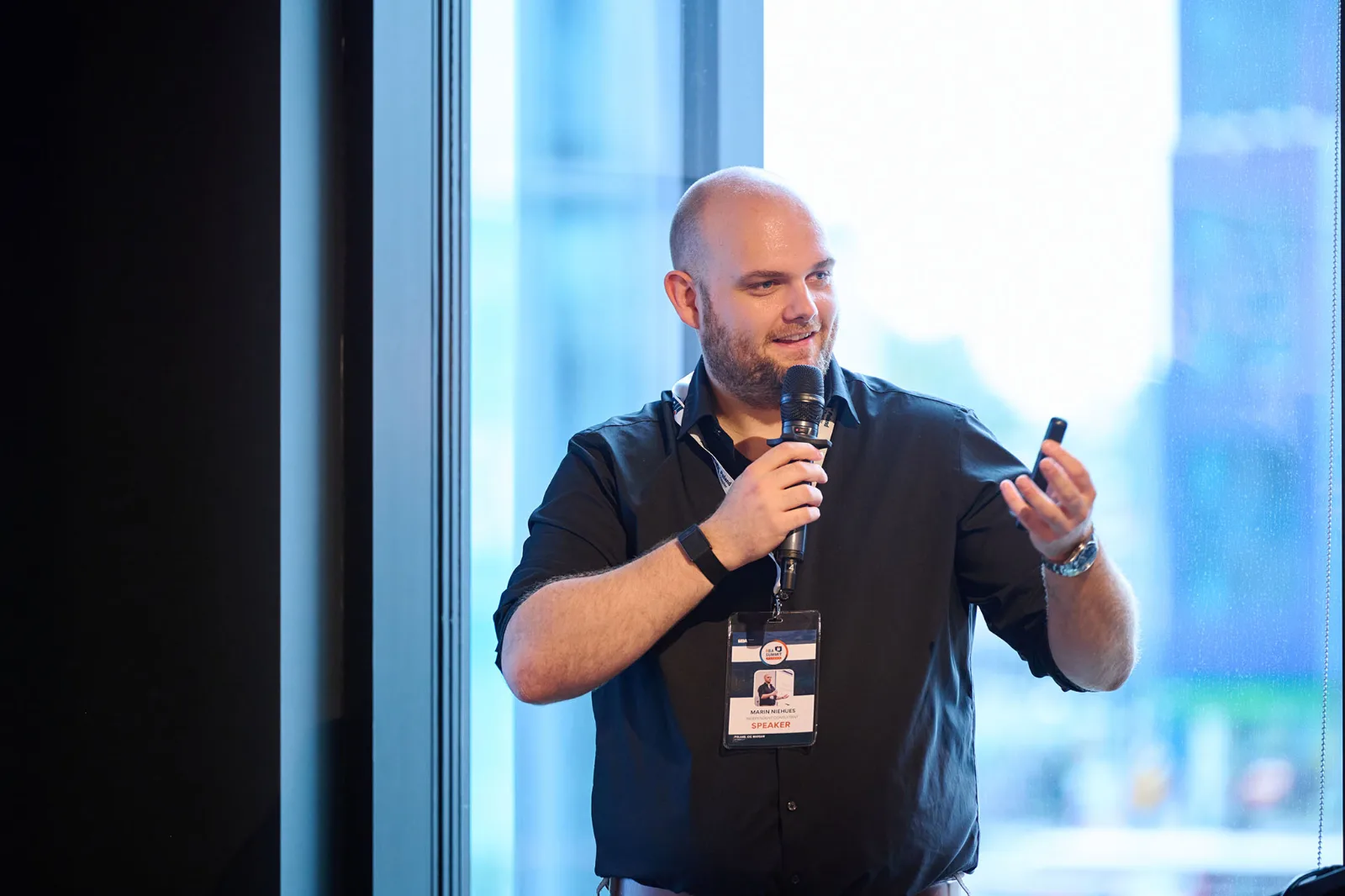
Marin Niehues is a management consultant and international speaker. With Niehues Consulting he works with organisations from scale-ups to DAX 40 corporations, and on stage he has collected more than 100 international conference invitations.
All articles by Marin Niehues