

Presenting in English: What Davos 2026 Means for Speakers
Presenting in English opens up the larger part of the conference market for professionals from German-speaking countries, and Davos shows the scale: the 2026 Annual Meeting of the World Economic Forum (WEF) in Davos-Klosters brought together, in January and under the theme "A Spirit of Dialogue", nearly 3,000 leaders from more than 130 countries, according to a report by Business Today. A gathering with participants from so many countries needs a shared working language, and in international professional circles that is usually English. In our analysis of 2,415 conferences with a public call for papers for 2026, Italy, the United Kingdom, Spain and the Netherlands together account for 341 conferences, almost four times the 88 in Germany. For speakers, this means that a talk in English multiplies the number of possible stages many times over, provided you prepare the abstract, the talk and the Q&A in the foreign language.
Presenting in English opens up the larger part of the conference market for professionals from German-speaking countries, and Davos shows the scale: the 2026 Annual Meeting of the World Economic Forum (WEF) in Davos-Klosters brought together, in January and under the theme "A Spirit of Dialogue", nearly 3,000 leaders from more than 130 countries, according to a report by Business Today. A gathering with participants from so many countries needs a shared working language, and in international professional circles that is usually English. In our analysis of 2,415 conferences with a public call for papers for 2026, Italy, the United Kingdom, Spain and the Netherlands together account for 341 conferences, almost four times the 88 in Germany. For speakers, this means that a talk in English multiplies the number of possible stages many times over, provided you prepare the abstract, the talk and the Q&A in the foreign language.
Davos 2026: what came together at the WEF Annual Meeting
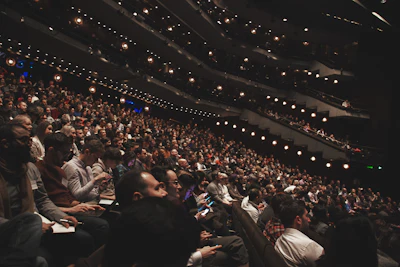
The World Economic Forum put its Annual Meeting under the theme "A Spirit of Dialogue" and invited participants to Davos-Klosters in Switzerland from 19 to 23 January 2026, where, according to the Business Today report, nearly 3,000 leaders from more than 130 countries were due to meet. That included around 400 representatives of politics, among them almost 65 heads of state or government, around 1,700 business leaders and close to 200 experts from civil society and academia. At the close, the Free Press Journal reported close to 3,000 participants from 130 countries and a record 400 top political leaders.
We use Davos here as a yardstick, because the guest list shows how international an audience can become. A gathering of people from more than 130 countries cannot do without a common lingua franca, and in international professional circles that role is, as a rule, played by English. That is our interpretation and not a statement by the Forum, since the reports do not say which language was spoken on the individual stages. The same mechanism applies one level down: a professional conference that draws participants from several countries often runs its programme in English and opens its call for papers to speakers from everywhere.
Presenting in English: what it means and when it pays off
Presenting in English means giving a conference talk in English, with an English abstract, English slides and an English Q&A. For professionals from the German-speaking world it pays off when the people in the room work or buy in English. If your future clients sit in the German-speaking Mittelstand, trade association events and professional conferences in your own language area often lead to the goal faster. Who sits in the audience and how those people listen is described in the article Who sits in the audience at an industry conference.
Choosing a language is therefore a decision about audience and competition. At an international conference, the programme committee, the group that decides on the submissions, places your proposal next to those from speakers from several countries. Some of these competitors bring English-language recordings. The committee looks in your bio for evidence that you know your subject from your own practice. Such evidence counts in any language.
Presenting in English in figures: how large the market is across the language border
Our analysis shows how many stages open up with English. It covers 2,415 conferences that publicly advertise speaking slots for 2026 and puts Italy at the top in Europe with 108 conferences, followed by the United Kingdom with 90 and Germany with 88. Anyone who submits only in the German-speaking world uses a small part of this, as the article Which European countries have the most conferences looking for speakers shows in detail.
These 341 conferences are an upper limit of what English opens up for you, because not every one runs its programme in English and not every one fits your subject. An example calculation with open assumptions makes the difference tangible. Assume that one in five of the 341 conferences runs its programme in English and fits your field: that gives around 68 further stages. If one in five of the 88 conferences in Germany fits as well, that gives around 18. The assumption of one in five is an estimate, and the ratio of 68 to 18 follows from the figures in the analysis.
The larger market comes with greater effort. You need an English abstract, a talk you deliver confidently in the foreign language, and answers to questions you do not know in advance. Travel and entry follow their own rules for conferences abroad, which the article Conferences outside Europe describes.
How to prepare a talk in English in five steps
A talk in English comes together in five steps, which you take in this order because each builds on the previous one:
- Check your audience: Establish in which countries your future clients work and whether they attend conferences in English. That tells you which countries and conferences are worth considering.
- Write the abstract afresh: The abstract is the short description of your talk that the programme committee reads. Write it directly in English for an international audience, with a problem, an approach and the benefit for listeners, and do not translate a German text word for word, because it often sounds stilted in English.
- Rehearse in front of an audience: Deliver the talk in full to two or three colleagues and ask them where terms or examples stay unclear for people from other countries.
- Prepare the Q&A: Collect the ten questions you are most likely to be asked after the talk and say the answers aloud in English.
- Record a short sample: A video of three to five minutes in English shows the programme committee how you present and lowers the risk for organisers of inviting an unknown speaker.
If you are still unsure in the foreign language, start with a conference in your own country that runs its programme in English. You travel only a short way and still speak to an international audience.
Why a single talk in English belongs in a plan
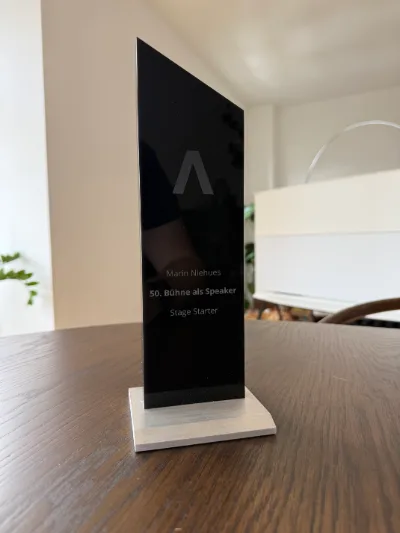
A call for papers is a selection process with an open outcome, even with an English abstract. Our founder Marin Niehues has received more than 100 invitations and has spoken at more than 50 conferences in 30 countries on six continents, and Sessionize named him Most Active Speaker in 2024 and 2025. Anyone who wants several stages a year therefore plans several submissions. How many submissions it takes to get an acceptance is worked out in the article How many abstracts to submit for one acceptance.
Assume you submit ten proposals a year and have an English abstract written that you adapt for all ten. You then work on the foreign language once and use it for every submission. The same goes for the talk, which you deliver after the rehearsal at each accepted conference with small changes. The effort for the language arises once, while the market in which you apply grows with every suitable English-language call.
Frequently asked questions
How do I find conferences for presenting in English?
You look for conferences that advertise their call for papers publicly and run their programme in English, and you check in the call which language the talk should be in. In our analysis of 2,415 conferences with a call for 2026, Italy leads Europe with 108 conferences, followed by the United Kingdom with 90.
Do I have to write an abstract in English afresh?
Yes, for an English-language conference the abstract should be written afresh for an international audience. A literal translation of a German abstract often reads stilted in English. The programme committee only checks briefly in a first round whether a proposal fits the programme.
How do I prepare for the Q&A after a talk in English?
You collect the ten most likely questions in advance and say the answers aloud in English. In a rehearsal with colleagues you find out which terms and examples need explaining for people from other countries.
Is presenting in English worth it for experts from Germany, Austria and Switzerland?
It is worth it if your future clients work or buy in English and sit in the audience at international conferences. If you serve the German-speaking Mittelstand, conferences in your own language area remain the shorter route.
How many countries and participants did the 2026 WEF Annual Meeting in Davos have?
The 2026 Annual Meeting of the World Economic Forum in Davos-Klosters, which ran from 19 to 23 January, had nearly 3,000 participants from around 130 countries, according to reports by Business Today and Free Press Journal. The theme was "A Spirit of Dialogue".

Marin Niehues is a management consultant and international speaker. With Niehues Consulting he works with organisations from scale-ups to DAX 40 corporations, and on stage he has collected more than 100 international conference invitations.
All articles by Marin Niehues