

AI conferences 2026: what the New Delhi summit means for speakers
The AI Impact Summit in New Delhi is one of the AI conferences 2026 that brought heads of state and government together, and according to the organiser its programme took place in February 2026 at Bharat Mandapam. According to Fortune on 23 February 2026, it closed with the New Delhi Declaration, which 88 countries and international organisations adopted, and with expected investment of more than 200 billion US dollars in India over two years. For speakers in German-speaking Europe, this shows how much attention the topic of AI draws to conference stages. Their own chances of speaking lie with industry conferences whose dates are already fixed, such as NVIDIA GTC in March, ICLR in April, The AI Summit London in June, GITEX AI Europe in Berlin from the end of June and IJCAI-ECAI in Bremen in August, and the submission deadlines of such events often close months before the date.

The AI Impact Summit in New Delhi is one of the AI conferences 2026 that brought heads of state and government together, and according to the organiser its programme took place in February 2026 at Bharat Mandapam. According to Fortune on 23 February 2026, it closed with the New Delhi Declaration, which 88 countries and international organisations adopted, and with expected investment of more than 200 billion US dollars in India over two years. For speakers in German-speaking Europe, this shows how much attention the topic of AI draws to conference stages. Their own chances of speaking lie with industry conferences whose dates are already fixed, such as NVIDIA GTC in March, ICLR in April, The AI Summit London in June, GITEX AI Europe in Berlin from the end of June and IJCAI-ECAI in Bremen in August, and the submission deadlines of such events often close months before the date.
What the AI Impact Summit in New Delhi means for AI conferences 2026
The facts come from a Fortune report of 23 February 2026. According to it, the summit lasted five days and brought together heads of state and politicians, along with the chiefs of large technology companies. It is the fourth summit in the series that began at Bletchley Park and continued via Seoul to Paris, and it was the first to take place in the Global South, which the official summit website also stresses. According to Fortune, 88 countries and international organisations adopted the New Delhi Declaration, and the United States and China have also backed it. It is non-binding, and its aims are democratic access to AI, expansion in health and education, and transparency.
Pledges of investment followed. Fortune quotes the Indian minister Ashwini Vaishnaw as expecting more than 200 billion US dollars for AI and deep tech in India over the next two years. It names 110 billion US dollars from Reliance over seven years, 100 billion US dollars from Adani for AI data centres by 2035 and 50 billion US dollars from Microsoft in the Global South by 2030.
This is our reading for you as a subject-matter expert: where governments and companies pool money and expectations at the same time, demand probably rises for people who can explain what AI changes in a specific field. The programme of the industry conferences where you speak also takes shape long before the date, and the organisers' schedules for 2026 are now fixed.
An AI conference comes in three kinds, and one of them is your stage
An AI conference is a professional event at which vendors, users or researchers present results and experience with artificial intelligence. The term covers formats that suit speakers in different ways.
The summit in New Delhi belongs to the first group, the political meetings between states, where governments negotiate declarations and action plans. The second group consists of industry conferences and trade fairs with a conference programme, where users show what they have built with AI. The third group is research conferences, where a specialist audience discusses scientific work.
The dates come from the organisers. ICLR, IJCAI-ECAI and The AI Summit London give them on their websites, NVIDIA has announced GTC in San Jose on its channel on X, and for GITEX AI Europe the events calendar of Visit Berlin lists the Berlin exhibition grounds.
Which AI conferences 2026 count for professionals in German-speaking Europe
For experts from German-speaking countries, two of the five dates are on the doorstep, GITEX AI Europe in Berlin and IJCAI-ECAI in Bremen. Both show how an organiser plans its year. At IJCAI-ECAI, the deadline for papers to the main track and the special tracks was 19 January 2026, according to its website. From then until the start of the conference on 15 August there are 208 days, or about seven months, and by 25 February 37 days have already passed since the deadline.
It follows that a slot at a large AI conference in 2026 can mostly no longer be arranged at short notice. If you still want to speak this year, look at smaller industry conferences on AI in your sector whose deadlines are still open. You find them with the method in the article How do I find the conferences that suit my topic?, and the article Which European countries have conferences looking for the most speakers shows where in Europe most conferences look for speakers.
The large stages outside Europe, GTC in San Jose and ICLR in Rio de Janeiro, follow their own rules for travel and submission. The article Is submitting outside Europe worth it? describes how submitting there pays off.
For AI conferences 2026, planning decides: a calculation for 2027
An example shows what this means for your calendar. Suppose you want two slots at AI conferences in 2027 and assume one acceptance for every ten submissions, then you need about 20 submissions. This assumption is a worked example and not a market figure. Spread over twelve months, that is just under two a month, and each needs an abstract and a speaker bio that fit the programme in question. How many submissions one acceptance realistically takes is worked out in the article How many abstracts to submit for one acceptance.
The deadlines set the rhythm. Organisers sometimes announce their dates a year ahead, and registration for GTC 2026 was open with an early-bird price until 2 February, according to the announcement. A calendar in which you collect the deadlines of next year's AI conferences as soon as they become known therefore pays off. How deadlines spread over the year is shown in the article Call for papers deadlines: when most conferences collect talk proposals.
How to choose your stage among the AI conferences 2026
From the five dates and the summit in New Delhi, you can derive a plan in four steps.
- Clarify your field: an AI conference is a target for your talk when your topic appears there, such as AI in mid-sized companies, in care or in sales. A talk on the summit theme of governance fits where regulation is on the programme.
- Choose the type of conference: a practical talk with figures from a project fits industry conferences and trade fairs with a conference programme. If you research scientific work, you submit to research conferences such as ICLR or IJCAI-ECAI.
- Read the deadline first: note two dates for every conference, the end of the call and the start of the event. The difference tells you how much lead time you will need in future.
- Prepare your abstract before the deadline: an abstract that names a concrete problem, your approach and a proven result can be adapted for several conferences. Which topics dominate business events is shown in the analysis in the article Which topics dominate business events and conferences.
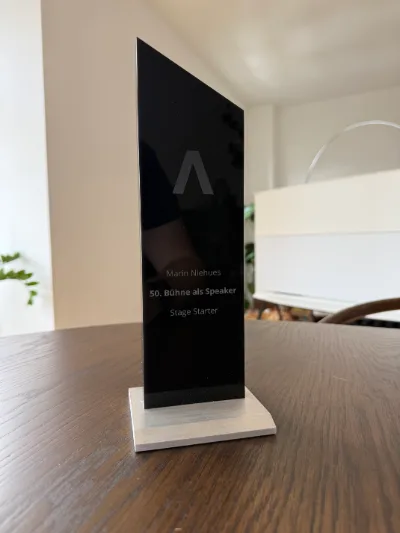
Marin Niehues, the founder of Stage Starter, has received more than 100 invitations on six continents and was named Most Active Speaker by Sessionize in 2024 and 2025. Anyone who plans many submissions early spreads the risk of a single rejection across several conferences.
Frequently asked questions
Which AI conferences 2026 are interesting for speakers from Germany, Austria and Switzerland?
Among those with a date in 2026 are NVIDIA GTC in San Jose in March, ICLR in Rio de Janeiro in April, The AI Summit London in June, GITEX AI Europe in Berlin from the end of June and IJCAI-ECAI in Bremen in August. Which of them suit you depends on your field and on whether you present practical experience or research.
What is the New Delhi Declaration?
The New Delhi Declaration is the closing declaration of the AI Impact Summit in New Delhi, which 88 countries and international organisations adopted, according to Fortune. It is non-binding, and its aims are democratic access to AI, expansion in health and education, and transparency.
Can I still submit a talk to the large AI conferences in 2026?
For the main track of IJCAI-ECAI 2026 the deadline passed on 19 January 2026, and the conference begins on 15 August. For other conferences it depends on the organiser, so look at the page of the respective call for papers and at smaller industry conferences with later deadlines.
How do I find an AI conference that suits my topic?
You look for conferences whose programme names your field, such as AI in sales or in industry, and check whether a call for papers is open. A speaker agency such as Stage Starter can do the research for you on request.
When should I submit talks to AI conferences?
Allow a lead time of several months, because at IJCAI-ECAI there were 208 days between the deadline and the start. If you want to speak in 2027, collect the deadlines in 2026 and submit several proposals, because not every submission is accepted.

Marin Niehues is a management consultant and international speaker. With Niehues Consulting he works with organisations from scale-ups to DAX 40 corporations, and on stage he has collected more than 100 international conference invitations.
All articles by Marin Niehues